


Based on the research paper: "Heavy Metal Concentrations in Particulate Matter: A Case Study from Santo Domingo" by Matos-Espinosa et al. (2025). This project was funded by the National Fund for Innovation and Scientific and Technological Development (FONDOCyT) No. 2020-2021-2B1-110 of the Ministry of Higher Education, Science and Technology (MESCyT) of the Dominican Republic.
The heart of the capital under the microscope
Santo Domingo is a city defined by its movement: the relentless flow of traffic, the expansion of its infrastructure, and the activity of its industrial belt. Yet suspended in that urban air travels a silent chemical burden: heavy metals. These elements, trapped in microscopic particles suspended in the air known as PM2.5 and PM10, represent one of the greatest challenges to modern environmental health due to their inability to degrade and their potential for bioaccumulation.
Historically, air quality management in the Caribbean has faced a critical challenge: the lack of systematic local data. As the densest urban and industrial core in the Dominican Republic, our capital breathes the consequences of accelerated growth without having had, until now, a technical baseline on its most persistent pollutants.
This research breaks with that inertia. During 2022, we set out to map the invisible trail of heavy metals in the National District, transforming environmental concern into rigorous scientific data. The goal was not only to document concentrations, but to establish an essential methodological precedent in a region where scientific evidence is often the scarcest resource.
How do we classify what we breathe?
To understand the impact of these pollutants, it is vital to classify Particulate Matter (PM) by its aerodynamic size, as this determines how deep it can penetrate the respiratory system:
- TSP (Total Suspended Particles): Total suspended particles (< 100 µm).
- PM₁₀: Inhalable particles (< 10 µm) that can reach the throat and lungs.
- PM₂.₅: Fine particles (< 2.5 µm) capable of reaching the pulmonary alveoli.
- PM₁ or ultrafine: Particles smaller than 1 µm.
It is important to specify that, for the purposes of this study, measurements focused exclusively on the PM₂.₅ and PM₁₀ fractions.
What are heavy metals, really?
In environmental management, we define heavy metals not only by their density (chemically, those with an atomic number greater than 20), but by their persistent behavior in the environment. Elements such as Iron (Fe), Copper (Cu), or Zinc (Zn) are essential in trace amounts for life, but at elevated concentrations, or in the case of non-essential elements such as Lead (Pb) or Cadmium (Cd), they can be highly toxic.
Their hazard rests on three pillars:
- Persistence: They do not degrade; they only transform or move between air, soil, and water.
- Bioaccumulation: They accumulate in the tissues of living organisms over time.
- Systemic toxicity: They can cause serious health damage even at minimal concentrations.
Results: What does the air in Santo Domingo reveal?
The research successfully met its objective of quantifying nine key metals. The main findings reveal a dominant presence of Copper (Cu) and Zinc (Zn) in both particulate matter fractions.
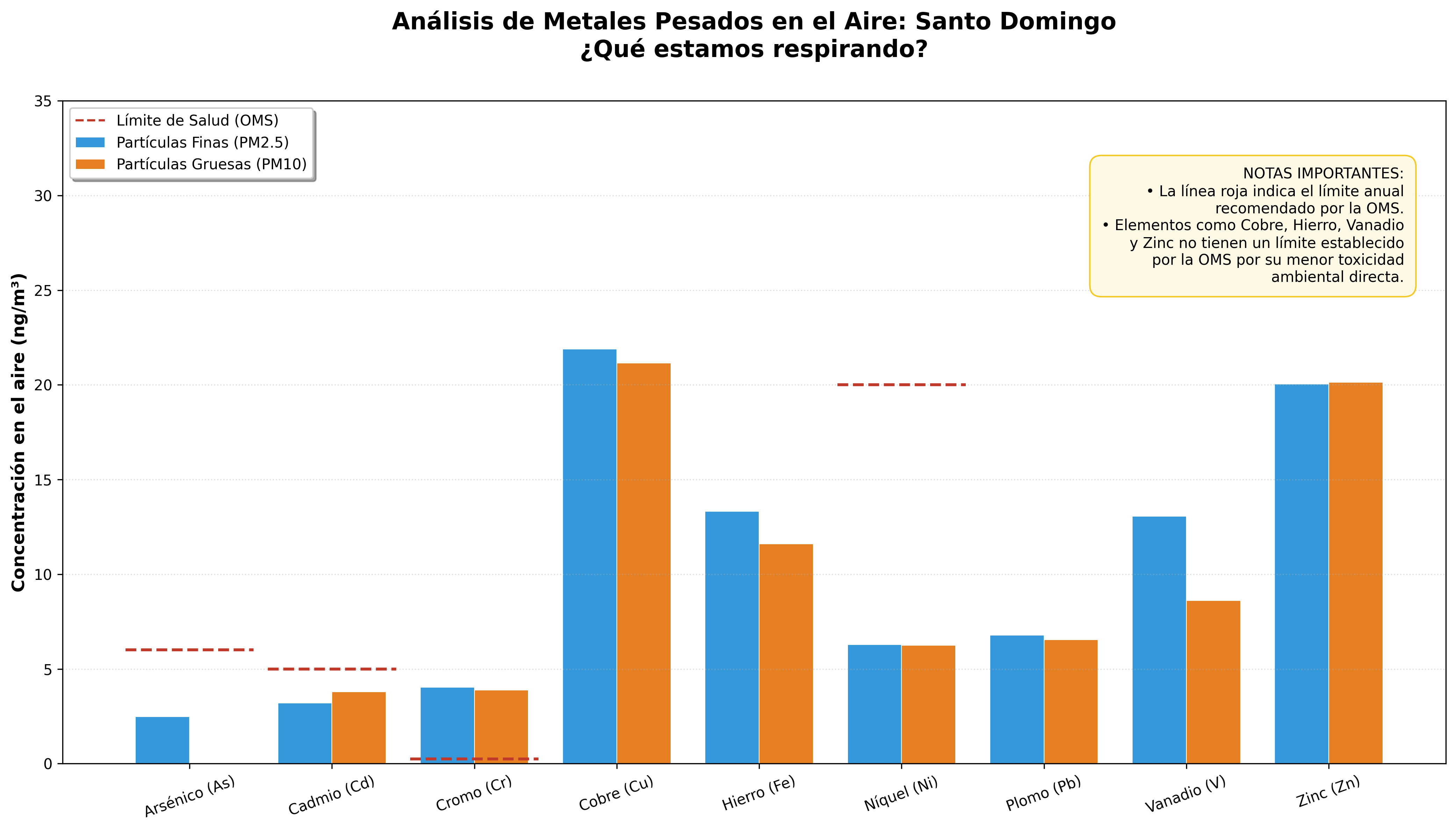
- Anthropogenic sources: The high concentrations of Cu and Zn suggest a direct influence from vehicular traffic, specifically from brake and tire wear and activities at automotive workshops.
- Residual contamination: Although lead was removed from fuels decades ago, we detected moderate levels of Pb and Ni, suggesting the persistence of past industrial and vehicular emissions.
- Regional context: When comparing our results with other Latin American capitals, the levels in Santo Domingo fall within the expected range for urban environments with limited resources — not unusually high, but not negligible either.
Toward evidence-based air management
It is important to emphasize that this study establishes a baseline. Although it did not include a direct epidemiological assessment, it provides the necessary data for future researchers to model health risk and population vulnerability.
This work represents a critical first step. The concentration profiles documented here are fundamental for designing regulatory interventions and public policies that protect the health of Santo Domingo's residents. By understanding what is in our air, we are better equipped to decide what actions to take to clean it.
References
- Matos-Espinosa, C., Delanoy, R., Hernández-Garces, A., Jauregui-Haza, U., & Martínez-Batlle, J.-R. (2025). Heavy Metal Concentrations in Particulate Matter: A Case Study from Santo Domingo, Dominican Republic, 2022. Atmosphere, 16(11), 1236. https://doi.org/10.3390/atmos16111236